
I am Tunisian, and the south is where my country feels most itself to me. It is also the part most often reduced to a single picture: a dune, a door, a postcard. This series of documentary photography in Tunisia is my attempt to look longer than that. It lives inside communities rather than passing through them, and it refuses the single story.
This Djerba and Tozeur photo essay brings together two places that sit at opposite edges of the south. Djerba is an island in the Gulf of Gabès, flat and white and open to the sea. Tozeur is an oasis town inland, beside the great salt flat of Chott el Djerid, where the desert begins in earnest. Between them runs a single thread: people holding on to who they are while the world around them changes.
I work as a Tunisian documentary photographer between Tunis and Doha, and most of my commissioned work is for NGOs, UN agencies and publications. The South is different. Nobody asked for it. It is the series I return to between assignments, slowly, because the people in it deserve more time than any brief would allow.
- What: The South, heritage and migration, an ongoing independent documentary series.
- Where: Djerba, Tozeur and central Tunisia.
- Who: Amazigh women, mothers and daughters in the oases, and sub-Saharan migrants living and working in the south.
- How: photographed slowly, at eye level, with informed consent and only after time was given.
Djerba: a language written on hands
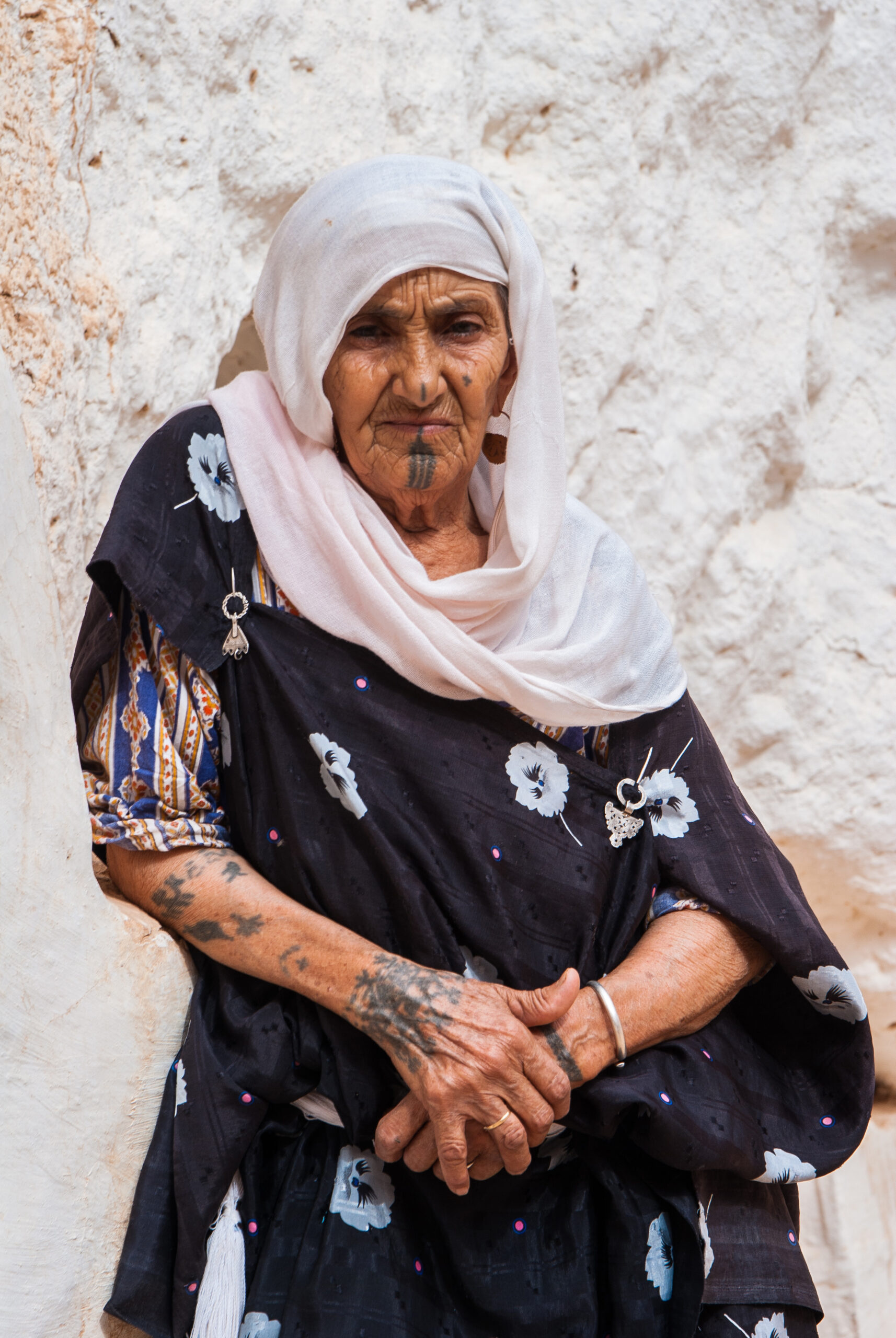
On Djerba, some of the oldest women still carry the tattoos they were given when they were young: marks on the chin and forehead, lines along the arms and the backs of the hands. They are part of an Amazigh visual language that is older than any of us, and it is disappearing with the generation that wears it.
I did not want to photograph the tattoos as ornament. I wanted the woman first, and her hands as part of who she is. In this portrait she leans against a whitewashed wall, her tattooed hands folded, silver brooches pinned to her wrap, looking straight back at the camera. Nothing is staged except the decision, which was hers, to stand still for a moment.
Djerba light is a particular kind of light. The island is low and the walls are limewashed, so in the middle of the day everything bounces and the shadows go pale. That is hard for landscapes and generous for portraits: a white wall becomes a reflector, and skin and fabric are lit from every side. I prefer to photograph elders on Djerba in the shade of a doorway or along a wall in the late morning, when the light is bright but soft, and nobody has to squint into the sun.
Portraits of elders also take patience of a different kind. Elders in places that attract visitors are often photographed without being asked, and it is understandable when some turn away. The only honest way I know to work is to sit, talk, explain who I am and what the pictures are for, and accept that the answer is sometimes no. A refusal is part of documentary photography in Tunisia too, and it protects the trust that makes the next portrait possible.
What the tattoos carry
Facial and hand tattoos were once common among Amazigh women across North Africa, and they carried meanings that varied by family and region: protection, belonging, beauty, a passage into adulthood. I am careful not to claim a single meaning for any mark I photograph. The women who wear them are the authorities, and when they choose to explain, I listen. When they do not, the photograph should still leave space for the mark to be theirs.
Tozeur: daughters of the oasis
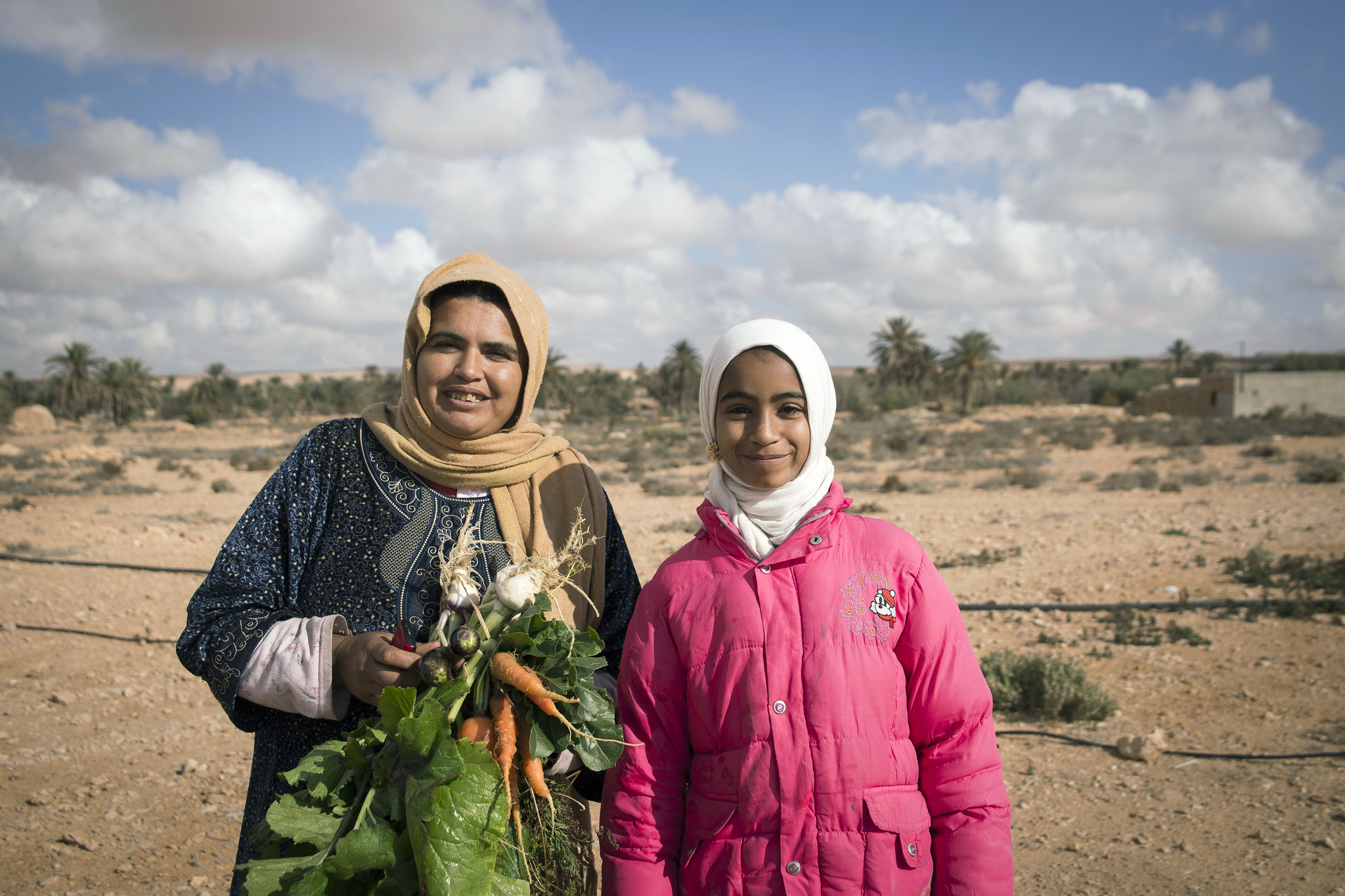
Tozeur sits at the edge of the Sahara, and the oasis around it is a world of palms, water channels and small family plots. The mothers I met there are raising daughters in a place where the land still decides much of the day.
This frame is one of my favourites from the series. A mother and her daughter stand side by side in the field, the mother holding a bunch of carrots just pulled from the ground. Both look straight into the lens and smile, the daughter in a white headscarf and a bright pink jacket, the palms of the oasis on the horizon behind them. Two generations, the same soil, and a quiet pride that did not need directing.
The Tozeur oasis is a layered landscape. Tall date palms make the top storey, fruit trees grow in their shade, and vegetables and fodder grow closest to the ground, all fed by channels that share the water between families. For a photographer that layering is a gift: the light arrives filtered and green, the background always has depth, and every frame says where it was made without needing a caption.
Photographing a mother and her daughter together means asking two people, not one. I explain to both, and I make sure the younger person is comfortable and not simply agreeing because a parent did. In this frame the field is open and the sky is wide. My decisions were about distance and how much of the oasis to keep behind them, and I kept enough to show that this land is theirs to work.
Tozeur beyond the postcard
Tozeur is known for its patterned brick architecture, its palm groves and the film sets in the desert nearby, and those are the pictures most visitors take home. They are beautiful, but they are not the town. The Tozeur I wanted for this essay is the one at the edge of the fields in the early morning, when families are already working and the light is still low across the ground.
The people who keep the south working
The south is not only its heritage. Over the past years, sub-Saharan migrants have become part of its streets and its economy: carrying, collecting, cleaning, building. Their labour is everywhere, and their faces are rarely shown with dignity.
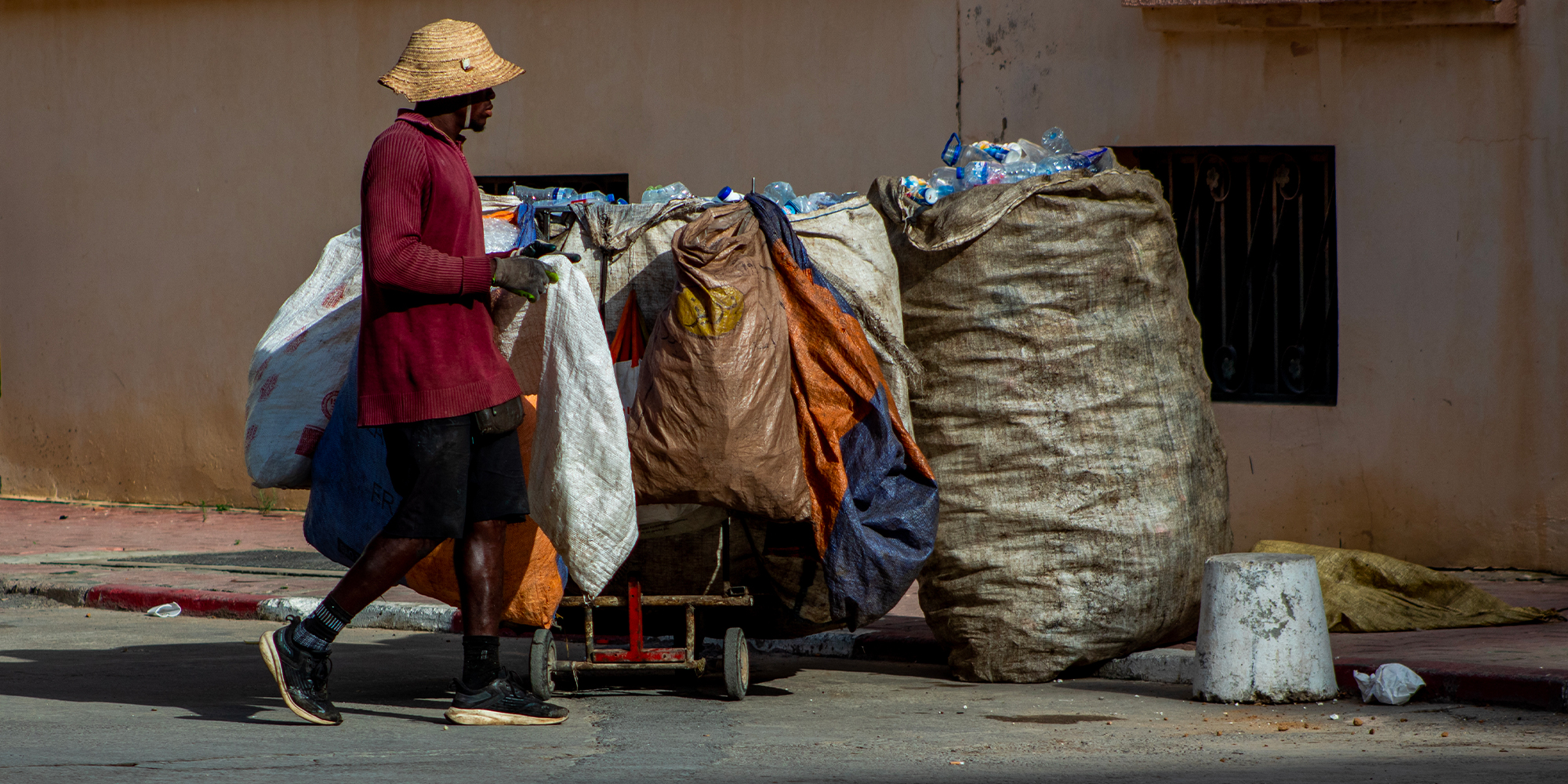
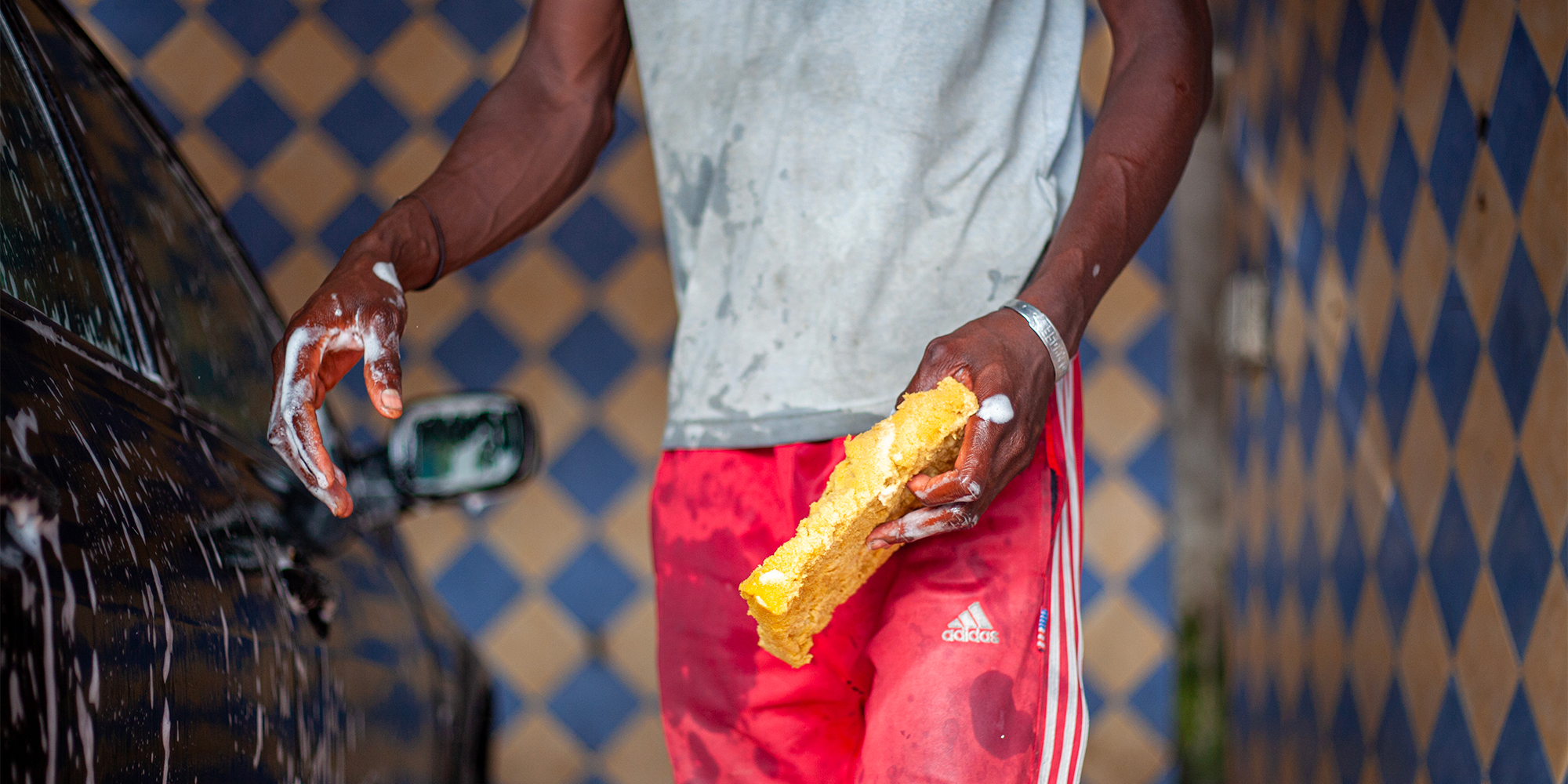
I chose to photograph work rather than hardship: a man pushing carts piled high with sacks, soapy hands washing a car by the roadside. These are the people the country’s south now depends on, and they belong in its story as much as anyone born there.
Photographing migrant workers carries real responsibility. A picture that seems harmless in a gallery can create problems for someone whose situation is uncertain. For these frames I kept the focus on hands, tools and work, I did not record names or exact places, and I asked each person whether they were comfortable with the image being published. That is the same standard I apply when I work as an NGO photographer, and it does not change because a project is personal.
There is also a question of tone. It is easy to make migrants look either heroic or hopeless, and both flatten them. I wanted ordinary dignity instead: a man at work, a careful pair of hands, a tiled wall and a yellow sponge. Ordinary is not small. In the south, ordinary work keeps everything moving.
How I work: documentary photography in Tunisia
Documentary photography only works when it is earned. For this series, and for every assignment I take for NGOs and publications, the same principles apply:
- Consent first. Every person photographed agreed to it, and understood how the image might be used.
- Time before the camera. I spend time with people before I photograph them. The portrait comes after the conversation, not instead of it.
- Eye level. I photograph people from their own height, never from above, never as victims or as decoration.
- Dignity in the edit. Images are chosen for how they represent the person, not only for how striking they are. Frames are never cropped or altered to change their meaning.
- Safety. For vulnerable people, especially migrants, I leave out names and locations that could put anyone at risk.
The same approach runs through my field work with correspondent Bel Trew for The Times and The Independent on Tunisia’s southern border, and the films I have made for the International Labour Organization and IPPF. You can see more of that work on my documentary practice page.
The South is ongoing. I return when I can, and the series grows slowly. If you are an editor, curator or organisation interested in publishing, exhibiting or commissioning work from it, I would be glad to talk.
Light in the south: field notes
People often ask what equipment I use for documentary work. The honest answer is that light and time matter far more than gear. The south of Tunisia has some of the most beautiful and most difficult light I know, and learning to read it changed how I photograph everywhere else.
On the island
Coastal light is bright, salty and reflective. The sea and the white walls fill in shadows, which flatters faces but can flatten architecture. I work early and late for exteriors, and use doorways, courtyards and covered markets in between. Wind is constant for much of the year, so headscarves, hair and fabric move; I treat that movement as part of the picture rather than fighting it.
In the oasis
Under the palms the light is dappled and changes minute by minute. That can be magical, but bright spots on a face are unforgiving. I look for open patches at the edge of the groves, where the light is even and the palms stay behind the subject as context. Out on the salt flat and the desert edge, the light becomes hard and graphic by mid-morning, which suits landscapes far more than portraits.
Heat, dust and care
Summer in the south is fierce. I plan the hardest walking for the first hours of the day, carry more water than seems necessary, and keep lens changes to a minimum when there is sand in the air. The people I photograph are working in that heat every day, and a good rule is never to ask anyone to stand in full sun for a picture that could be made in the shade.
Photographing people in Djerba and Tozeur: advice
If you are a photographer planning to work in the south, a few habits will make your pictures better and your presence lighter. None of them are rules I invented; they are what years of listening to people in front of my camera have taught me.
- Ask, every time. A smile and a gesture towards the camera is not consent. Ask clearly, and accept a no without trying to change it.
- Be especially careful with women and children. In many families, photographing women or children requires the agreement of the person and often of the family. Take the time to ask properly.
- Learn a few words. Even a little Tunisian Arabic changes a conversation. People notice the effort, and the portraits that follow are warmer.
- Do not pay for poses. Paying people to look poor or traditional produces false pictures. If you want to give something back, buy from local makers, or share prints.
- Respect sacred and private places. Mosques, synagogues, homes and family plots in the oasis are not backdrops. Ask before you enter or photograph them.
- Send the pictures back. When you can, share the images with the people in them. It is the simplest way to turn a transaction into a relationship.
These habits are also how I brief teams on commissioned work in the region. If you are an organisation planning field photography or impact films in Tunisia or the Gulf, my NGO photography and video production page explains how I plan consent, safeguarding and delivery on assignment.
Why being Tunisian helps, and why it is not enough
Being a Tunisian documentary photographer opens doors. I share the language, I understand the jokes and the silences, and people place me quickly. But the south is not my home town, and Amazigh families on the island or in the oases have histories that are not mine. Being from the same country makes it easier to start a conversation. It does not give me the right to tell someone else’s story without listening first.
Why this Djerba and Tozeur photo essay has four frames
This essay shows four photographs, and that is a deliberate choice. The archive behind The South is much larger, but documentary work is made in the edit as much as in the field. Every frame has to earn its place by saying something the others do not.
The grandmother carries memory and heritage. The mother and daughter carry continuity and the land. The two frames of migrant workers carry the present: who does the work now, and how the south is changing. Remove any one of them and the story becomes simpler and less true. Add ten more of the same kind and the reader stops looking.
How I sequence a photo essay
I start wide and personal, move to place, then end on the present tense. Portraits are given room to breathe, often alone in the layout, while working images sit side by side so they read as a rhythm rather than single heroic moments. Captions stay factual and short: where, who in general terms, and what is happening, never an interpretation the person in the frame did not offer.
The same discipline applies to documentary films. The slow motion sequence near the top of this page uses the same four frames, shown whole and never cropped, because changing a frame to fit a format can change its meaning. You can see more of that thinking in my ILO decent work films, in the wider documentary practice and across the journal.